What is Tnuki?
Tnuki is the only AI app you need for life sciences sales: one tool that does the work of ChatGPT, SciLeads, and ZoomInfo. It runs on the Tnuki Life Sciences Universe, our proprietary dataset covering both Academia and BioPharma, kept current with live searches on every request. Every rep gets equipped with everything they need to prospect and to grow existing accounts. Campaigns hand them a ranked plan of attack, matched to your strategy and filtered to their territory. Tnuki Chat works like a researcher on demand: it maps an account, finds the decision makers, and verifies contact info. Tnuki Brief delivers a daily update on what changed in their territory. And every outreach draft is written in your voice, with each claim verified against a source. The result: reps spend their day selling instead of searching.
How is Tnuki different from using ChatGPT or Claude for sales research?
ChatGPT and Claude are great at language, but they can only see the open web and their training data. They have no scientific databases, no live clinical or regulatory signals, no verified contact info, and no memory of your accounts. Tnuki keeps the ease of a chat and adds what selling actually requires: a curated database of BioPharma and Academia with live searches on top, 40+ scientific and regulatory databases, and contact info verified across 10+ providers. The emails are a craft of their own: we have tuned Tnuki’s drafts hard against the usual AI failures, so they are not too long, not presumptuous, and never hard to follow. Fake-personalization tricks that sound like AI are banned outright, and every claim in a draft is verified against a source you can click to check.
How is Tnuki different from ZoomInfo, SciLeads, or AI SDRs?
Each of those tools covers part of the job. ZoomInfo gives you filters over a general business database: strong on company size and job titles, blind to the science. It can’t tell you a company’s lead program, trial phase, or latest readout. SciLeads knows life sciences but works the same way: keyword searches over a dataset that updates on their schedule. AI SDRs like 11x.ai and Artisan send high volumes on autopilot, and you give up control of what goes out. Tnuki does the whole job in one place: it researches accounts deeply, ranks the prospects worth your time, verifies contact info, and drafts outreach that your team reviews and sends.
How does Tnuki find decision makers and their contact info?
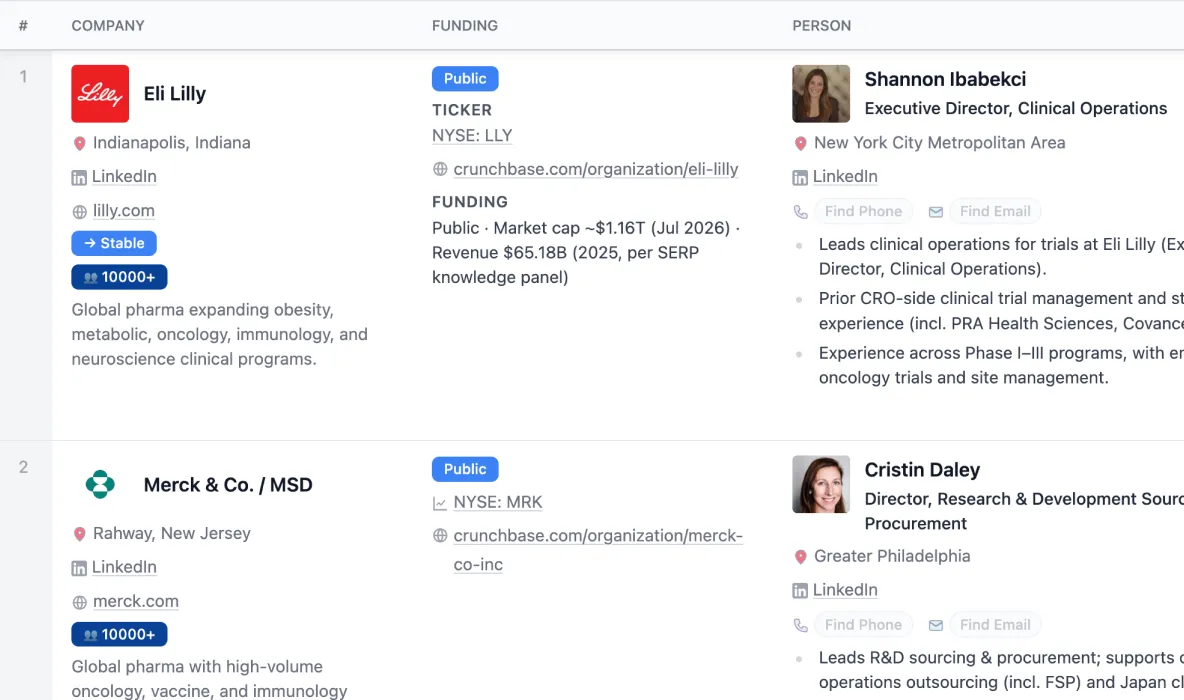
In one click, Tnuki maps the people who matter at any account: who they are, what they own, and why they’re the right entrypoint. Contact info comes from waterfall enrichment: Tnuki checks more than 10 data providers and returns emails and phone numbers only after they pass verification, along with each person’s LinkedIn history.
How does Tnuki keep outreach out of spam?
Quality. An email stays out of spam when it genuinely matters to the person reading it. Tnuki starts by finding the right buyer: companies buy in different ways, and Tnuki hones in on the purchaser your product is actually for. It then researches that person and anchors the draft on one real, verifiable pain point. No templates. A person reviews and sends every message. That focus protects your domain: inbox providers punish senders over a tiny number of spam complaints, and relevant, human-sounding email keeps replies up and complaints near zero.
Can Tnuki replace my other sales tools?
That’s how most teams use it. Tnuki combines the jobs of a general AI chat, a life sciences lead database, and a B2B contact database in one tool, so you’re not paying for three subscriptions or hopping between tabs. For our typical customer, that cuts spending on prospecting tools by about half.
Is Tnuki only for life sciences?
Tnuki is purpose-built for life sciences sales. Coverage is deepest across BioPharma and Academia: biotech, pharma, and the university labs and research institutes that buy alongside them. It extends to everyone who sells into that world: diagnostics, lab tools and instruments, CROs and CDMOs, and scientific software. The agents are tuned to the signals that decide deals in this market, like clinical and regulatory milestones, FDA actions, grants and funding, and new publications. The research reflects how life sciences actually buys, not a generic company profile.
What data sources does Tnuki use?
Tnuki pairs its own curated database of BioPharma and Academia with live searches on every request, so results are current instead of waiting on a refresh cycle. Its agents read 40+ scientific and regulatory sources (PubMed, ClinicalTrials.gov, NIH RePORTER, openFDA, Semantic Scholar, and more), plus business data covering 1B+ professional profiles and 60M+ companies, with contact info verified across 10+ providers. They also watch news, funding databases, and 1,000+ buying-signal sources. Every result links back to where it came from, so your team can check it.
Can Tnuki do market intelligence, not just prospecting?
Yes. The same agents that build your Campaigns can write an account dossier, map a therapeutic area or modality, lay out a competitive landscape, and chart the buying committee inside a target account. Whether you’re building pipeline or sizing a market, you get the depth of a research team at the speed of a chat.




 Ellen Halloran
 Arjun Sethi
 Peter Vance
 Grace Lim
 Tom Brennan
 Daniel Park
 David Okonjo
 Mei Tan
 Marisol Reyes